- PRODUCTS
- Security Platform
- BioStar X | On-Prem Security
- BioStar Air | Cloud Security
- BioStar 2
- Access Control
- Access Control Units
- Biometric ReadersNEW
- RFID Readers
- Mobile Credential
- Peripherals
- Wireless Door Locks
- SOLUTIONS
- SUPPORT
- ABOUT
- device_hubHUB





- Latest press releases from Suprema


How Suprema and essentry Are Improving the Access Experience
By Bob McKee
If you’ve been following Suprema over the past few years, you’ve probably noticed we’re talking more about technology partnerships than we used to. That’s intentional. While our commitment to biometric identity hasn’t changed, the way customers deploy security solutions has. They’re looking to connect systems in smarter ways.
That’s why partnerships have become such an increasingly important part of Suprema’s strategy. We have deep expertise in biometric identity authentication and access control, but our solutions are almost always deployed within a much broader security ecosystem. By working with companies whose technologies complement our own, we can help customers solve more of the challenges they face every day.
Over the coming months, I’d like to introduce you to some of the technology partners we work with and explain why those relationships matter. Each partner contributes a different area of expertise, and by working with them, we’re able to help customers build powerful, customized solutions that better fit the way they operate.
Let’s begin with essentry – a German company whose integration with Suprema focuses on transforming the access experience for visitors. I want to start with this particular partnership because when the visitor experience is handled well, it leaves a positive first impression on organizations. It also enhances physical security in the entrance area and beyond through automated two-factor authentication. If you stopped by the Suprema booth at ISC West, you may have seen our integration with essentry in action.
If not, you can watch this 30-second video.
While visitor management and access control are separate systems, they are really two parts of the same identity and access management process. Whether someone is an employee, contractor, or visitor, the questions are the same. Who is this person? Why are they here? What areas should they be allowed to access? For what time period? And can we demonstrate that those policies were followed?
The difference between employees and visitors is where and when that process begins.
When an employee arrives on site, the organization has already established their identity, enrolled them in the access control platform, issued a credential, and assigned permissions. They can proceed straight to a turnstile, elevator, or secured entrance, and begin their day.
By contrast, a visitor is a completely different story. None of these steps have been done yet. Before the visitor can be granted physical access, the organization first must establish who they are, verify why they’re there, obtain the necessary approvals, and define and assign the specific access they should receive.
From the visitor’s perspective, the experience should be convenient and efficient. From the company’s perspective, the process must be highly trustworthy, easy to manage, and meticulously documented.
This is where essentry excels.
Essentry specializes in the digitalization of access governance processes. Its solution verifies the personal identities of visitors and then, through its integration with Suprema, automates the management of each authorized person’s access throughout their visit. Using biometric technology and artificial intelligence, essentry is able to achieve the highest level of security for facilities, employees and guests.
The essentry platform manages all the steps required to carry out an access process automatically and securely. It handles everything from invitations, security briefings, and NDAs, to identity verification and the granting of permissions, all the way to comprehensive documentation in the Analytics Dashboard—and all of this in the respective local language.
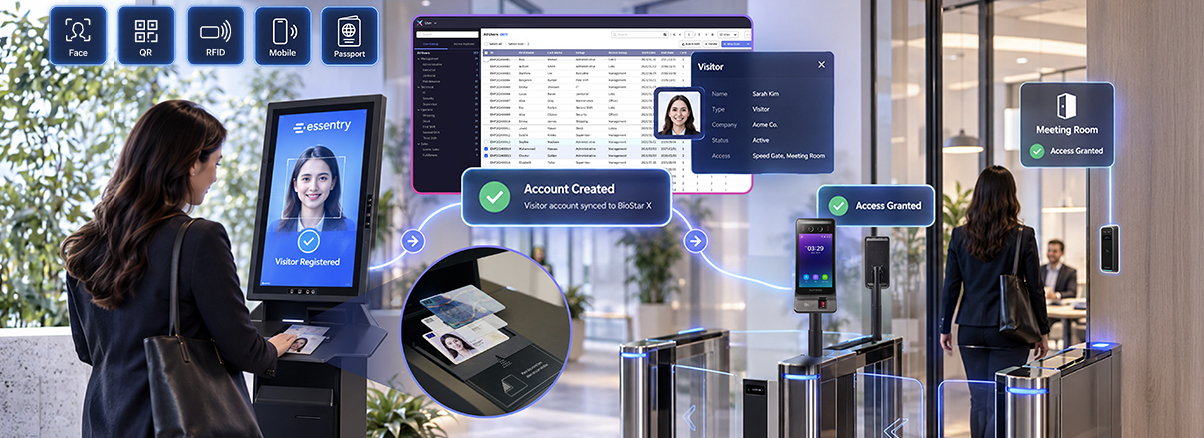
Essentry's strength lies in its ability to verify identities at a very high level. Upon arrival at a site, visitors complete enrollment by presenting their government-issued ID, which is authenticated using facial matching and liveness detection. Visitors can be verified beyond a doubt in less than 30 seconds, in just 3 steps.
Step 1.
ID Verification: Using a variety of light sources, essentry verifies the authenticity of identification documents (ID cards, passports, driver’s licenses, etc.). Depending on the document and the issuing country, this may involve up to 20 different security features—both visible and invisible.
Step 2.
Liveness-Detection: After document inspection, the kiosk 3D camera captures an image of the person standing in front of the device. Before this image is used for biometric facial matching, the system confirms that a genuinely live, physically present person is standing there — not an artifact or impersonation attempt, known as a presentation attack.
Step 3.
In the final step, the system compares the live image of the person — which has passed liveness detection — against the photo on the identity document. This 1:1 verification answers a single question: Is the person standing at the kiosk the same person pictured on the ID? The algorithm extracts biometric templates from both images: mathematical representations of facial geometry, including distances and proportions between eyes, nose, mouth, chin, and forehead. These templates are compared and produce a similarity score. If the score exceeds a defined threshold, the match is confirmed.
Once that trusted identity has been established, the integration with Suprema extends that trust into the access control system.
Using integrated Suprema technology, the visitor is enrolled using facial authentication, fingerprint authentication, or both – depending on the organization’s security requirements. The biometric identity, enrolled at the essentry kiosk, is then communicated to the Suprema platform, so the same enrolled biometric can be used to authenticate the visitor directly at Suprema’s devices throughout the duration of their visit, creating a seamless, frictionless experience from check in to access. The biometric enrollment is communicated to Suprema platform, allowing the visitor to authenticate using their enrolled biometric throughout the duration of their authorized visit.
In deployments where centralized biometric storage isn’t permitted, essentry can write each individual’s biometric template to a temporary access card during enrollment. It takes only 20 seconds to issue a card. Then, the visitor presents the card along with their face or fingerprint at secured access points, where the Suprema reader compares the live biometric to the template stored on the credential before granting access.
In either case, the result is a visitor experience that is both extremely convenient and secure. Organizations gain greater confidence that only authorized individuals are accessing protected areas, while visitors can move efficiently throughout the facility without an escort. When each visit is complete, essentry ensures that access privileges are revoked and automatically removed from the access control platform.
Equally important, the entire visitor process – from the arrival time, access permissions granted, and security briefings conducted, to security alerts for IDs or biometric facial matching – is documented, providing organizations in highly regulated industries with a comprehensive audit trail.
Together, essentry and Suprema create a seamless identity lifecycle for visitors. It’s an excellent example of why partnerships matter. No company can be best at every aspect of physical security. By bringing together specialized expertise in visitor management and biometric identity authentication, customers benefit from a solution that’s stronger than either company could deliver alone.
We've got more partner stories coming in this series, so keep an eye out for the next one.

