- PRODUCTS
- Security Platform
- BioStar X | On-Prem Security
- BioStar Air | Cloud Security
- BioStar 2
- Access Control
- Access Control Units
- Biometric ReadersNEW
- RFID Readers
- Mobile Credential
- Peripherals
- Wireless Door Locks
- SOLUTIONS
- SUPPORT
- ABOUT
- device_hubHUB





- Latest press releases from Suprema


Data centers around the world are quietly rewriting the rulebook for building security. Instead of relying on a patchwork of standalone devices, operators are moving toward intelligent, identity-first protection models that treat every person, credential, and access event as part of one continuous record. As AI workloads and cloud services push global capacity to new highs, facilities are under pressure to deploy security that is identity-aware, fully traceable, and seamless from the outer perimeter down to the server rack.
In this landscape, success no longer comes from bolting on more hardware. It comes from orchestrating a unified, identity-centric ecosystem where every access event can answer four basic questions: who entered, what they touched, who else was nearby, and how the incident can be reconstructed after the fact. That expectation is reshaping procurement standards, turning fingerprint and facial authentication, integrated visitor management, and video-linked access logs from “nice-to-have features” to baseline specifications for new builds and high-security upgrades.
Suprema has positioned itself at the center of this shift, building layered, identity-led architectures that bring together multi-factor biometric authentication, intelligent access control, and audit trails under BioStar X integrated with a video surveillance system. In an industry where a single physical security lapse can quickly turn into a contractual dispute or a reputational crisis, Suprema's capacity to deliver identity-assured, fully traceable protection across data centers and modern commercial buildings has become one of the clearest reasons the company is regarded as a global leader in access control and physical security.
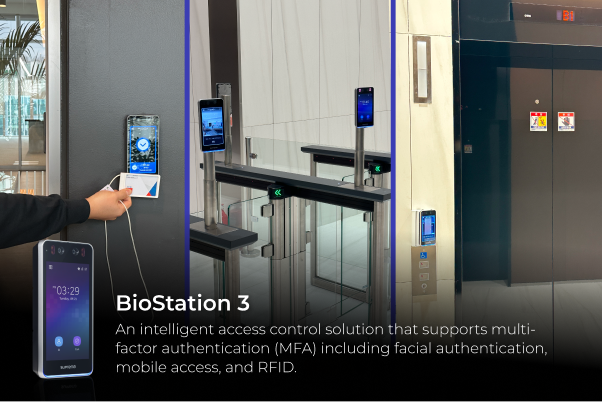
Korea’s major IT companies Gabia, Megazone,
and Sejong Telecom have adopted BioStation 3 and BioStar 2 for their data centers.
Source: ARCHIBUILD July/August 2026

