- PRODUCTS
- Security Platform
- BioStar X | On-Prem Security
- BioStar Air | Cloud Security
- BioStar 2
- Access Control
- Access Control Units
- Biometric ReadersNEW
- RFID Readers
- Mobile Credential
- Peripherals
- Wireless Door Locks
- SOLUTIONS
- SUPPORT
- ABOUT
- device_hubHUB





- Blogs & Articles


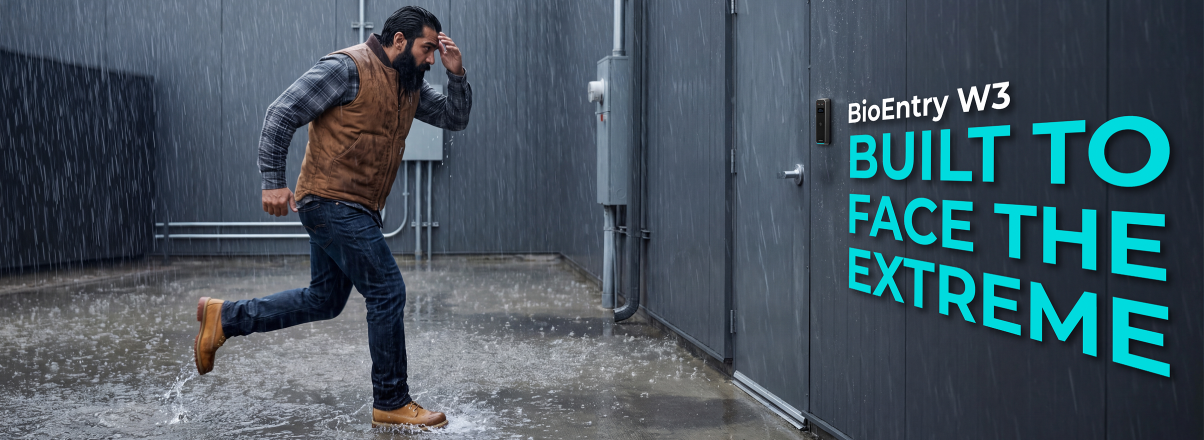
Deploying secure physical access at exposed perimeters or industrial gates requires hardware engineered specifically to withstand environmental wear. The BioEntry W3 delivers industrial grade AI facial authentication with a compact, rugged built, designed for high-demand deployments.
Key Takeaways
Five core reasons the BioEntry W3 thrives at demanding perimeters:
-
Uncompromised Physical Durability. Verified IP67 ingress protection and IK08 impact resistance safeguard sensitive internal sensors against heavy dust, rain, and severe physical force.
-
No LCD, a design differentiation. BioEntry W3 skips the LCD that would otherwise display registered photos, using LED-based feedback instead. It's a privacy-focused design choice that also removes a fragile, exposed component from the housing.
-
Speed, capacity, and hygienic touchless access. BioEntry W3 matches faces within 0.2 seconds and holds up to 30,000 face credentials (Template on Mobile) ensuring quick, hands-free authentication that eliminates entrance queues.
-
Purpose-Built for Critical Applications. Engineered for data centers, logistics hubs, critical infrastructure, and exposed outdoor perimeters where continuous uptime is non-negotiable. Its compact, mullion-compatible housing also fits narrow door frames and tight mounting spots that bulkier readers can't.
-
Multi-factor authentication support. Combines facial recognition, mobile credentials (NFC/BLE), and RFID in a single terminal to adapt to evolving access policies.
What makes a biometric reader "industrial grade"?
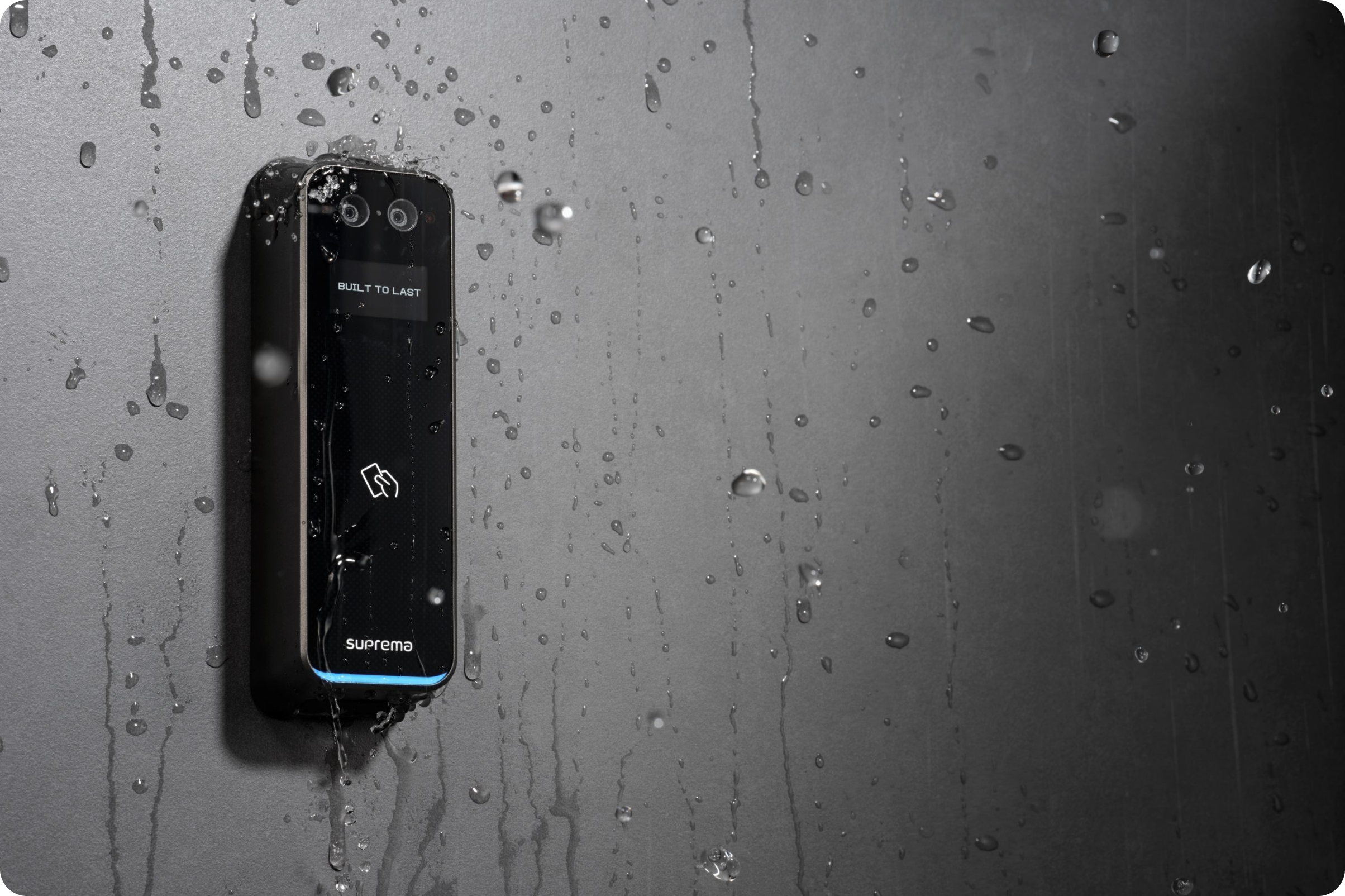
An industrial-grade biometric reader is one built to keep authenticating reliably in conditions that would degrade or disable standard hardware: dust, moisture, temperature swings, and physical impact. The label isn't about a feature list. It's about whether the reader still works after six months at an exposed loading dock.
Ratings, not adjectives
Vague terms like "rugged" or "heavy-duty" don't tell an integrator anything actionable. What matters are documented, testable ratings: IP for ingress protection, IK for impact resistance, and a defined operating temperature range. BioEntry W3 carries IP67 ingress protection and IK08 impact resistance, with an operating range of -20°C to 50°C. Those numbers are what a specifier can put in a project document.
Why this matters for integrators
System integrators are the ones who get the callback when a reader fails in the field. A device that's specified for an environment it can't actually handle turns into a maintenance ticket, a downtime window, and a credibility problem with the client. Choosing hardware with documented protection ratings up front removes that risk before installation day.
Why does IP67 and IK08 protection matter for outdoor access control?
IP67 and IK08 matter because they're the two ratings that determine whether a reader survives the two most common failure points at an exposed entrance: water and dust getting inside the housing, and physical contact damaging the unit. Without both, an outdoor deployment is a bet.
What IP67 actually protects against
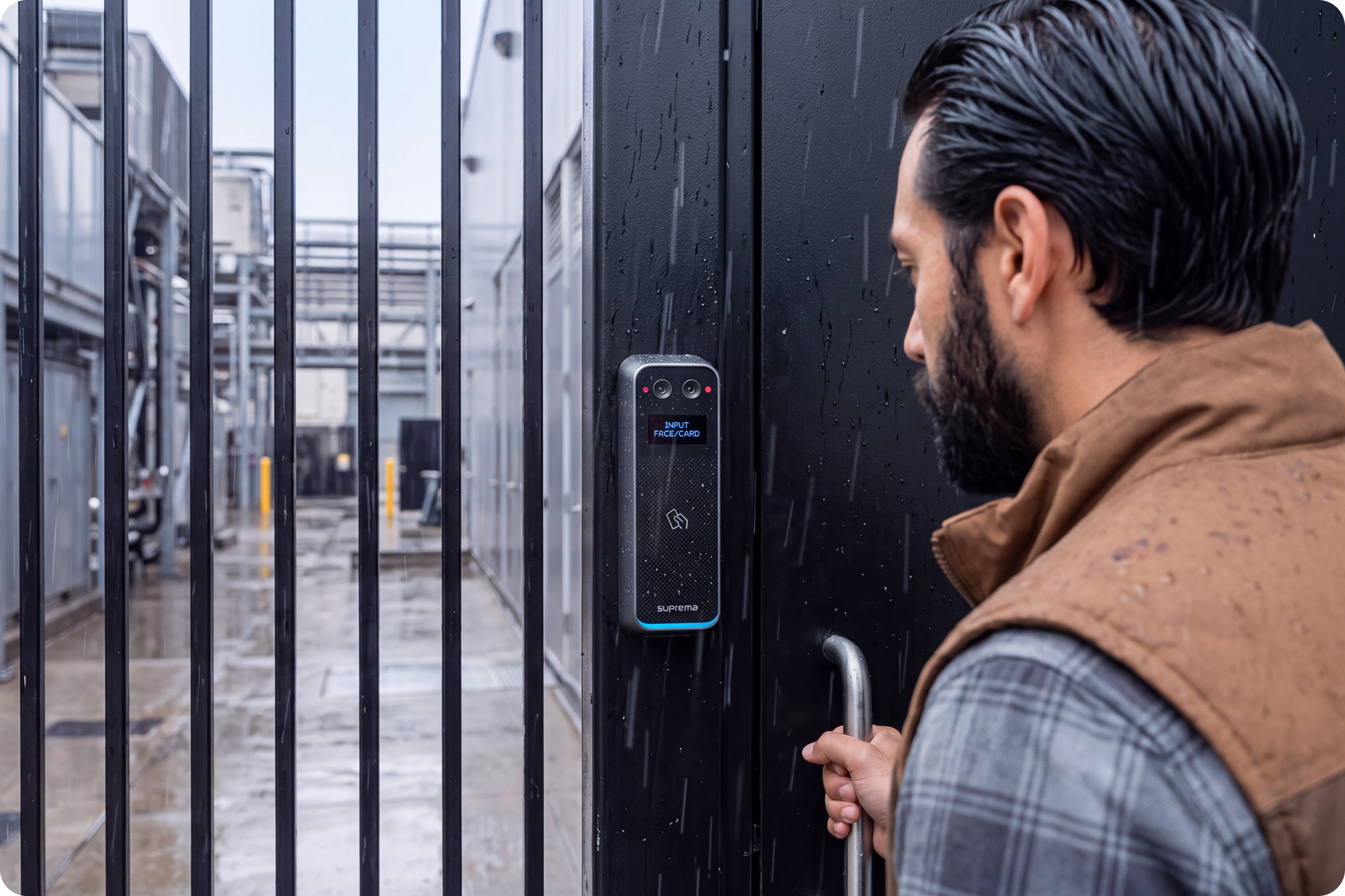
The "6" in IP67 means the housing is fully sealed against dust ingress. The "7" means it can withstand temporary immersion in water. Together, that covers the two conditions outdoor readers face most often: blowing dust at industrial sites and rain or washdown at exposed entrances. On BioEntry W3, this is documented as protection against dust and water intrusion, positioned as part of the product's durable build.
What IK08 covers that IP ratings don't
IP ratings say nothing about impact. IK08 measures resistance to mechanical force, whether that's an accidental knock from a forklift, a dropped tool, or contact from foot traffic near a low-mounted reader. For entrances where the reader sits in a busy or unsupervised path, impact resistance is as relevant as weatherproofing.
The environments where this combination gets tested
Perimeter gates, restricted technical areas, dust-prone facilities, and exposed building access points all put both ratings to work at once. A reader that handles rain but not impact, or impact but not dust, only solves half the problem.
Does a screenless design mean lower biometric performance?
A screen has no bearing on how a facial authentication engine performs. It's an input/output component for a menu system, not a factor in matching accuracy or processing speed. Conflating the two is a common but incorrect assumption in the access-control market.
Where the "no screen, lower value" assumption comes from
Most access-control hardware buyers are used to associating a display with configuration options and status feedback. When a reader has no screen, the instinct is to read that as a stripped-down or entry-level product. That instinct maps display presence to capability, which isn't how facial authentication hardware actually works.
What a screenless design changes instead
Removing the display removes an exposed component that's vulnerable to moisture, impact, and glare, and it frees up space for a more compact housing. BioEntry W3 uses that space for a slim 50 × 160 × 34.15 mm form factor. The screenless design is a deliberate part of the product's durability and installation profile, not a cut corner.
What actually determines authentication performance
Matching speed, credential capacity, and the AI engine behind the reader determine performance. BioEntry W3 matches faces within 0.2 seconds and supports up to 30,000 face credentials, independent of whether the unit has a display. That engine isn't unique to this model; it is powered by the same AI facial authentication engine found in Suprema's flagship BioStation 3 series (BioStation 3 and BioStation 3 Max) delivering high-tier precision in a slim, screenless design.
How does multi-credential support fit into a modern access terminal?
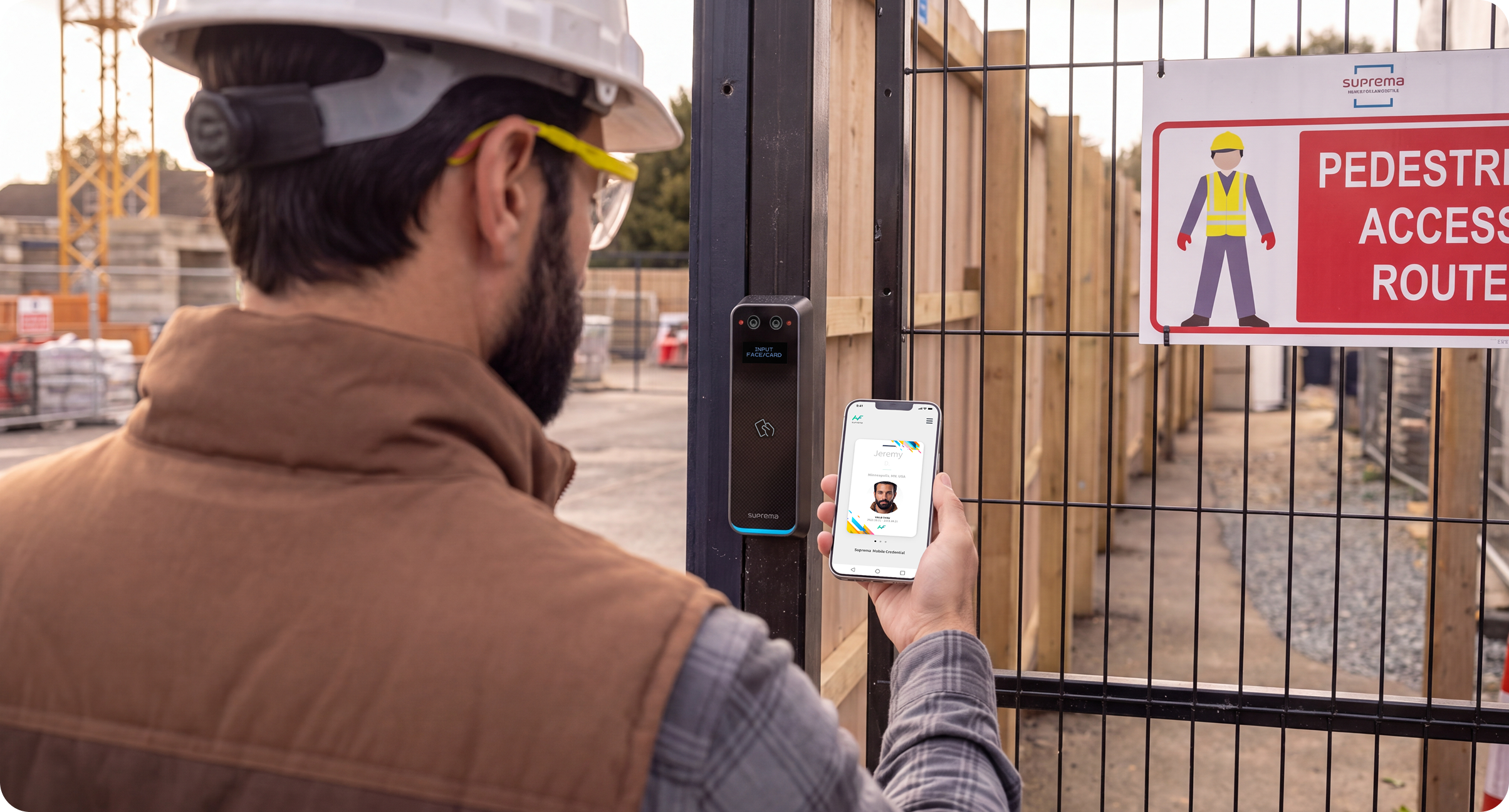
Multi-credential support matters because no single deployment relies on one credential type across its entire lifecycle, and a reader that only handles facial authentication limits how it can be deployed. A multi-credential access terminal covers facial, mobile, and card-based authentication in one unit.
Facial authentication as the primary method
AI-powered facial authentication is the core interaction for BioEntry W3, backed by Live Face Detection to guard against spoofing attempts.
Mobile and card credentials as fallback and flexibility
NFC and BLE mobile credential support, along with RFID, give integrators options for phased rollouts, visitor access, or sites where mobile credentials are the operational standard. This flexibility matters more in markets, where RFID and mobile-driven deployments are already common, than the ones built primarily around biometric-first workflows.
Why this reduces long-term integration risk
A terminal that supports multiple credential types reduces the chance that a site's access-control policy outgrows its hardware. That's a practical consideration for procurement and IT decision-makers evaluating total cost of ownership, not just the initial installation.
What use cases benefit most from a vandal-proof biometric access reader?
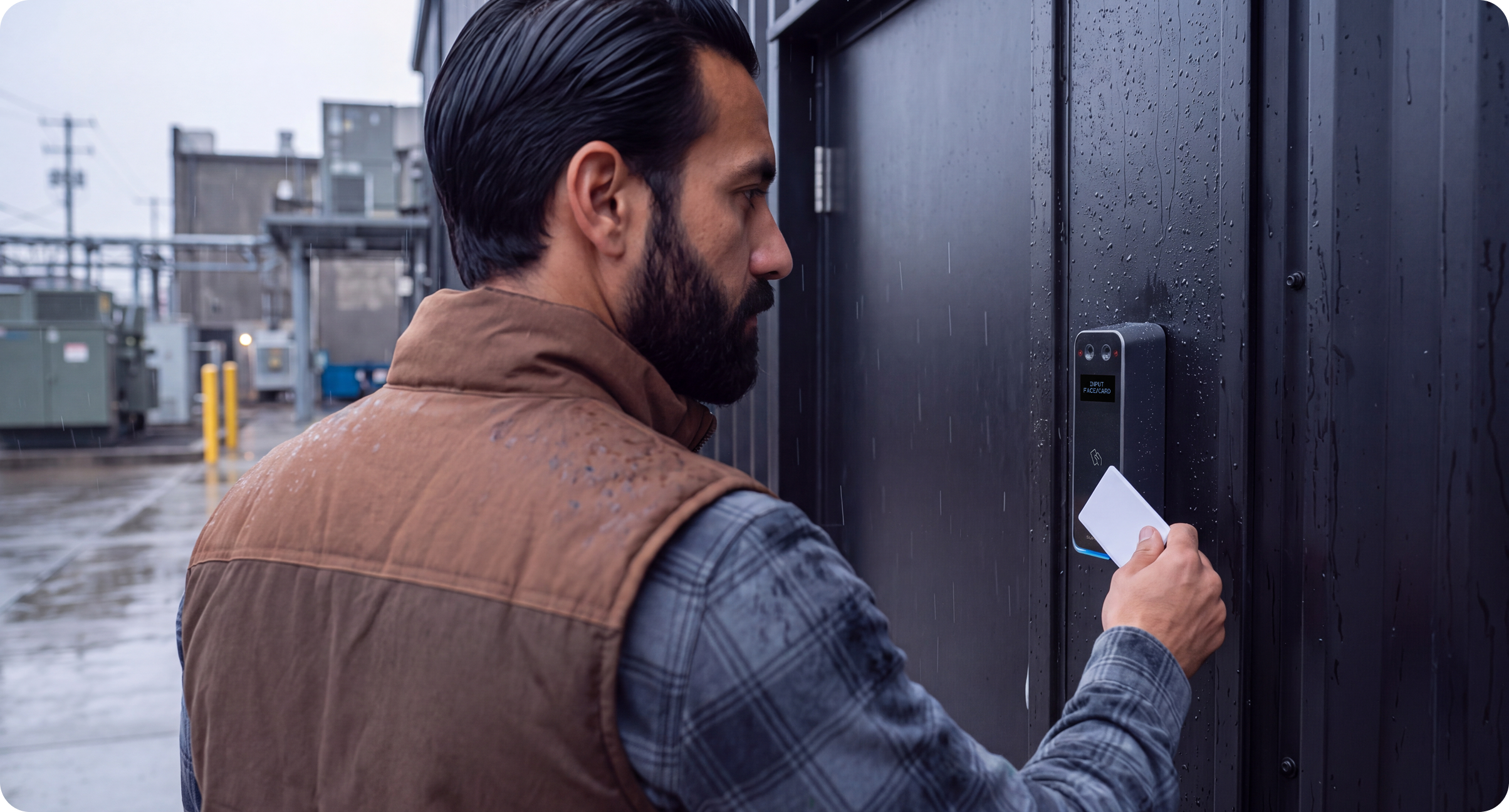
Environments with high foot traffic, limited supervision, or exposure to accidental contact benefit most, because those are the conditions where impact resistance and ingress protection get used rather than sitting idle on a spec sheet. Internal deployment feedback points to a specific set of these environments for BioEntry W3.
Data centers and critical infrastructure
Perimeter entrances and restricted technical areas in data centers and critical infrastructure sites need authentication that doesn't create a security gap if the hardware fails. Continuous uptime at these access points is part of the operational requirement, not a nice-to-have.
Industrial and logistics environments
Manufacturing floors, warehouses, and logistics hubs combine dust, temperature variation, and physical traffic near entrances. A reader mounted at an exposed access door in one of these settings is handling conditions that a standard indoor unit wasn't built for.
Outdoor perimeter and exposed entrances
Gates and building access points that sit outside the building envelope face weather exposure directly. This is where IP67 and IK08 do the most work, and where the case for an outdoor facial authentication reader over an indoor-rated one is clearest.
The specification decision for demanding entrances
An access-control reader earns its price the day something goes wrong: dust working into a sensor, condensation creeping past a worn seal, a hard freeze overnight. Specifying hardware for an exposed perimeter or an industrial site isn't about counting features. It's about whether the reader is still authenticating reliably six months later.
For security directors, integrators, and consultants weighing this reader against the alternatives, three things hold up under scrutiny:
-
Protection that's documented, not implied. IP67 and IK08 are testable, certified ratings a project spec can reference directly — not adjectives on a data sheet.
-
Credential support that doesn't lock in one access policy. Facial authentication, NFC/BLE mobile credentials, and RFID cards all run natively on the same terminal, eliminating single-policy lock-in.
-
A design built to reduce lifecycle costs. Fewer emergency dispatches, fewer unit replacements, fewer gaps in coverage over the life of the deployment.
Durability gets BioEntry W3 onto the shortlist. Performance and security are why it stays there.
Frequently asked questions (BioEntry W3 FAQ)
1. What is BioEntry W3?
BioEntry W3 is Suprema's compact AI-powered facial authentication reader, built for access-control environments where hardware needs to hold up under conditions a typical indoor reader isn't rated for.
2. What are the key specs of BioEntry W3?
BioEntry W3 measures 50 × 160 × 34.15 mm, matches faces within 0.2 seconds, and stores up to 30,000 face credentials. It's rated for an operating temperature range of -20°C to 50°C.
3. What protection ratings does BioEntry W3 carry?
IP67 for ingress protection and IK08 for impact resistance. IP67 covers dust and water intrusion; IK08 covers resistance to physical force from impact or contact. Both are the ratings integrators typically ask for when specifying hardware for exposed or high-traffic entrances.
4. What credential types does BioEntry W3 support?
Facial authentication is the primary method, backed by NFC and BLE mobile credentials and RFID cards. That covers biometric, mobile, and card-based access in a single terminal.
5. What environments is BioEntry W3 built for?
Data centers, critical infrastructure, industrial facilities, logistics environments, and outdoor perimeter access — anywhere an exposed entrance and continuous uptime are part of the requirement.
6. What regulatory certifications does BioEntry W3 meet?
BioEntry W3 complies with FCC Part 15 (Class A) in the US, Industry Canada's licence-exempt RSS rules, and the EU's Radio Equipment Directive (2014/53/EU), carrying the CE mark as a Class 1 radio device. It also holds regional certifications including UKCA, KC, RCM, BIS, ANATEL, and RoHS. Full details are documented on Suprema's regulatory information page.

