- PRODUCTS
- Security Platform
- BioStar X | On-Prem SecurityNEW
- BioStar Air | Cloud Security
- BioStar 2
- Access Control
- Access Control Unit
- Biometric Readers
- RFID Readers
- Mobile Credential
- Peripherals
- Wireless Door Locks
- SOLUTIONS
- SUPPORT
- ABOUT
- device_hubHUB





- Blogs & Articles


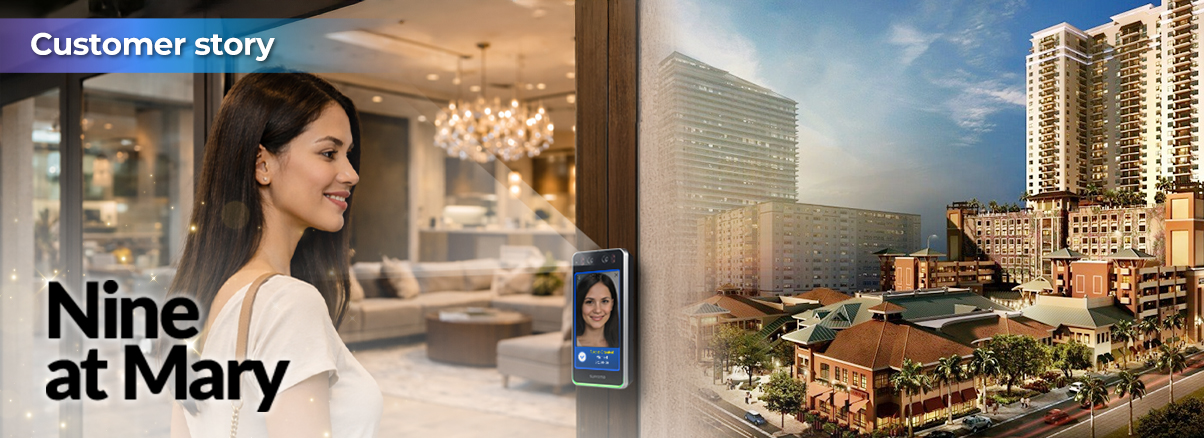
Walk into many hardware stores today and, for around $40, you can quickly duplicate your access fob. That convenience might seem harmless, but for a luxury high-rise, it poses an obvious and unacceptable security risk. Properties that market exclusivity can’t afford to rely on credentials so easily undermined.
That’s why Nine at Mary Brickell Village (Nine) – a modern, 390 unit, 34-story condominium in the heart of Miami’s financial district – moved to upgrade its access control system. Its recent, site-wide deployment of a facial authentication solution reflects a deliberate investment in technology that matches the building’s brand of premium living.
Assistant Property Manager Luis Fernandez describes Nine’s demographic as mostly young professionals and medical students. “We’re located in a bustling area with one of the highest levels of foot traffic in Miami-Dade County, so ingress security is a top concern.”
In addition, the building offers extensive amenities, including a resort-style pool with cabanas, club room, lounge with billiards and poker tables, fitness center, yoga studio, meeting spaces, dog park, Zen Garden, and multi-level garage – all requiring consistent, secure access.
The Integrator’s Perspective: Choosing the Right Fit
Miami IT integrator, IT Works, has long specialized in condominium network infrastructure. As Project Manager Bruno Santos explains, the shortcomings of traditional access control systems drove the firm's move toward biometrics.
"It's very difficult for management companies to keep track of fobs or RFID credentials and perform reliable audits. Anybody with a fob can walk right in – whether they belong there or not."
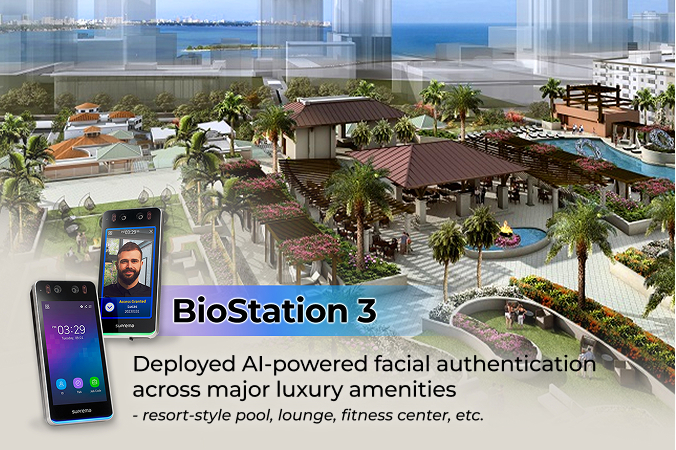
When Suprema released its facial authentication solution, BioStation 3 (BS3), IT Works recognized a match for Miami's luxury condo market. Santos describes the devices as modern in both form and function.
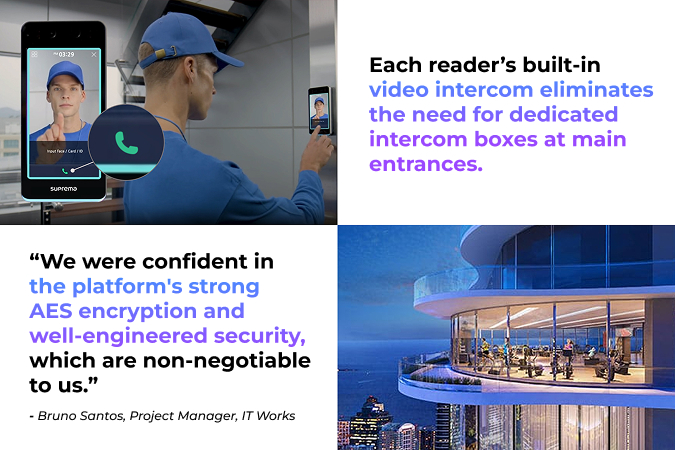
"They're small and, eye-pleasing., and Iin addition to facial authentication, BS3 supports multiple credential types, including QR codes and digital credentials within a single reader, and it can function as a video intercom. After performing thorough testing, we were confident in the platform's strong AES encryption and well-engineered security, which are non-negotiable to us as an IT company."
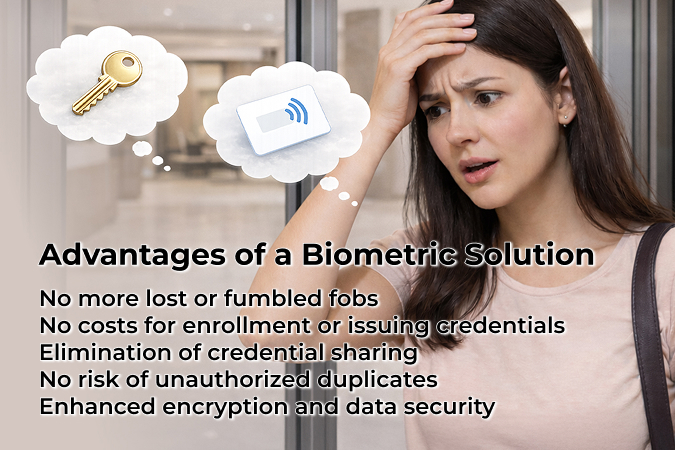
From there, IT Works met with decision-makers at Nine, including residents, to educate them on the advantages of a biometric solution. These include:
ㆍNo fumbling for or losing fobs
ㆍNo cost to enroll each user or issue a credential
ㆍNo ability for credential sharing
ㆍNo unauthorized duplicate fobs in circulation
ㆍMore secure encryption and data handling.
"We emphasized what the solution could do, underscoring its reliability and superior daily experience for residents. We also stressed that this particular system offered the flexibility to accommodate residents uncomfortable with facial authentication, allowing them to use mobile credentials or encrypted, high-security fobs because the same door readers can handle all three."
From Fobs to Faces: Making the Transition
Rolling out a new access control system in a residential property the size of Nine requires meticulous planning, as it impacts hundreds of residents and dozens of shared spaces. According to Santos, IT Works collaborated worked closely with Nine's management team to ensure a smooth and minimally disruptive transition.
"The first step was migrating data from the old fob system into BioStar Access Control Management Software. That gave us a clean baseline without residents losing access in the interim," Santos explains. Each imported record carried detailed access rights – who could enter each secure area and during what times. It also defined each user's elevator and stairwell access by floor. By mapping these permissions into the BioStar platform, IT Works ensured that the new system launched with the same granularity and reliability the residents were accustomed to, but with far better security and auditability.
The subsequent enrollment of residents’ biometrics was a carefully coordinated process. It began with IT Works’ deployment of a model facial authentication station in the lobby to demonstrate the system in action and allow residents to try it for themselves. Then, individuals were scheduled in small groups to have their credentials captured--, a process that Santos says took less than a minute each. And anyone not ready to commit to facial authentication was issued a new fob or a mobile credential instead.
"The goal [of the rollout process] was never to force biometrics, but to show people how much easier it is. Over time, many who started with fobs asked to enroll their face because they saw how much more convenient it was," Santos notes.
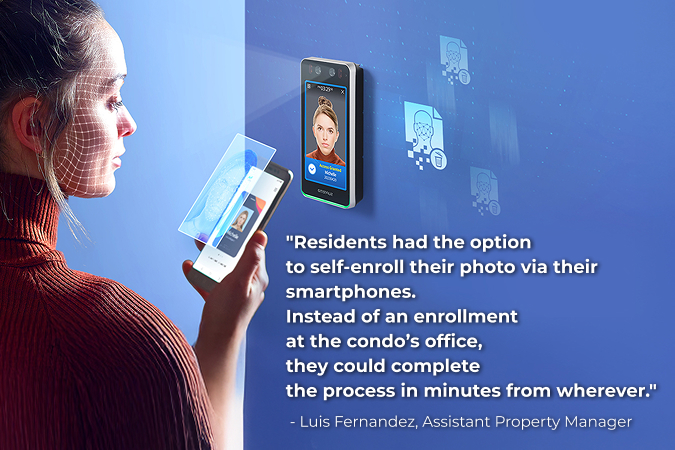
As an alternative, residents had the option to self-enroll their face biometrics via their smartphones – a capability that proved especially valuable in a community like Nine, where most residents are young, mobile-first professionals. Instead of attending an enrollment session at the condo’s management office, they could complete the process in minutes from wherever they were. Fernandez noted calls BioStar’s self-enrollment feature as a “big win” for Nine’s operations team, since it dramatically reduced the burden of scheduling. It also reinforced the sense among residents that the building’s new system was user-friendly.
As for the installation process, tTwenty-three readers were gradually deployed throughout the complex, beginning with lower-traffic amenity spaces like the pool.
"We wanted residents to try the new readers first in the most low-stakes settings in order toand give everyone a chance to enroll. By the time we got to the main entrances, almost everyone was in the system," Fernandez explains.
Throughout this period, each reader’s built-in video intercom capability made the phased transition seamless. Anyone not yet enrolled could instantly connect with the lobby’s 24/7 security officer, who could grant access remotely through the newly secured door.
For the garage, new credentials were not necessary. Residents already had RFID transponder stickers on their vehicles, and IT Works was able to transfer all of that data into the new system. But fFor the first time, each transponder was tied to eachan individual's profile, giving management far greater visibility and control over vehicles entering the property.
Some fine-tuning was required for the elevator readers, which, at first, were overly sensitive and picked up faces from too far away – unlocking more than one floor at a time. IT Works adjusted their range and positioneding so the readers so that they only recognized residents standing directly in front of them, ensuring precise, floor-specific access.
Fernandez stressesd that the system’s success ultimately came down to the people behind it. He credits IT Works with orchestrating a smooth migration, configuring the solution to Nine’s unique needs, and providing responsive, ongoing support.
"The system is great, but without a team that could guide us through every detail and answer all our questions, our experience would have been quite different."
The Payoff
Nine's upgraded security posture stands in stark contrast to that of its state under the previous fob-based system. Every access event is now logged with a corresponding visual snapshot. Fernandez enthusiastically notes,
"If there's ever a question about who has accessed a space, we can immediately match the image to the associated user. This creates an audit trail we never had before."
The system's dashboard gives management, like Fernandez, a real-time view of activity across the property, allowing security staff to view and respond instantly to denied access attempts or suspicious activity.
The solution has also put an end to unauthorized Airbnb and short-term rentals – a problem that plagues many luxury properties and can erode security and community standards.
"You can't share your face with a renter," says Santos.
"We had a few instances early on where residents tried to move fobs around for short-term guests, but with the access reader's embedded cameras, we could see that the person using the credential wasn't the registered user. Our team was able to shut down those situations within 24 hours, and since then, we haven't had any issues." By eliminating the ability for outsiders to cycle in and out under the radar, Nine has strengthened resident trust and reinforced its standing as an exclusive community.
In terms of technology overhead, the new system has consolidated multiple security functions within a single solution. The video intercoms built into each reader eliminate the need for dedicated intercom boxes at main entrances. Similarly, security guards can remotely grant visitors access to secure spaces within the building, as appropriate, wiping out the need for a separate visitor management platform.
Market Impact
The biometric access control system at Nine at Mary Brickell Village is more than infrastructure; it’s a critical asset that reinforces long-term property value. By ensuring only authorized individuals can access residences and amenities, the solution plays a vital role in maintaining Nine’s prestigious standing in Miami’s competitive luxury market.
As more multi-family residential properties consider security upgrades, Nine at Mary Brickell Village proves that biometric access control is both a safeguard and a selling point.
“Technology that combines the ultimate in convenience and protection helps set properties like Nine apart,” says Fernandez. “It’s a valued amenity, just like the pool and fitness center. It preserves the exclusivity that made the building desirable in the first place.”
Connect with industry leaders and join the conversation about this article by following us on LinkedIn, Facebook, and Instagram. Share your insights and expand your professional network.

