- PRODUCTS
- Security Platform
- BioStar X | On-Prem Security
- BioStar Air | Cloud Security
- BioStar 2
- Access Control
- Access Control Units
- Biometric Readers
- RFID ReadersNEW
- Mobile Credential
- Peripherals
- Wireless Door Locks
- SOLUTIONS
- SUPPORT
- ABOUT
- device_hubHUB





- Customer Stories
- A list of case studies from Suprema


-
[India] Air India Upgrades to Touchless Access Control Across 700+ Doors.
THE CUSTOMERAir India is India’s premier airline, with more than 90 years of heritage, connecting over 79 destinations internationally and domestically. Part of the Tata Group and a Star Alliance member, it operates a diverse network of corporate offices, pilot and cabin crew training academies, and aircraft maintenance, repair, and overhaul (MRO) facilities, each with distinct access and security requirements that shape daily operations.
At its aviation training academy alone, approximately 10,000 to 12,000 trainees arrive every week. Many visit for only a short period each year, creating pressure to keep secure access and enrollment fast, efficient, and disruption-free.
As Air India modernized its headquarters and expanded its facilities, it wanted to replace conventional card-based access with facial authentication and create a more seamless, connected workplace experience.
Air India worked with Suprema and Magnum, Suprema's long-standing system integration partner in India. Magnum introduced Suprema to Air India and led system integration, enterprise application connectivity, and custom workflows.
THE CHALLENGEAir India's goal was not simply to replace card readers. At its headquarters, leadership wanted to move from conventional RFID-based access to a fully touchless, face-only experience for employees, consultants, and visitors, improving speed and consistency at entry points.
The wider project also spanned facilities with different infrastructure requirements. Existing buildings relied on established cabling and access control systems, while newer locations could adopt different architectures. Air India needed to modernize access without replacing usable infrastructure, preserving investment while scaling the rollout.
Integration was equally important. Access control needed to connect with existing identity management, visitor management, employee applications, and payroll-related workflows rather than operate as a standalone security system.
Enrollment presented a particular challenge at the aviation training academy. Pilots and cabin crew are frequently away from the office, and many trainees visit for only a week each year. Because they do not always access corporate email on their phones, some missed advance facial-enrollment invitations that expired after 24 hours for security reasons. With thousands arriving each week, Air India needed a practical way to complete secure enrollment on arrival and avoid delays at controlled entrances
THE SOLUTIONAfter an initial proof of concept, Air India selected Suprema's end-to-end access control solution, including the BioStar 2 platform, BioStation 3 facial authentication terminals, CoreStation 40 controllers, and supporting door and I/O modules. Magnum led integration, installation, training, and commissioning, with support from Suprema's technical team.
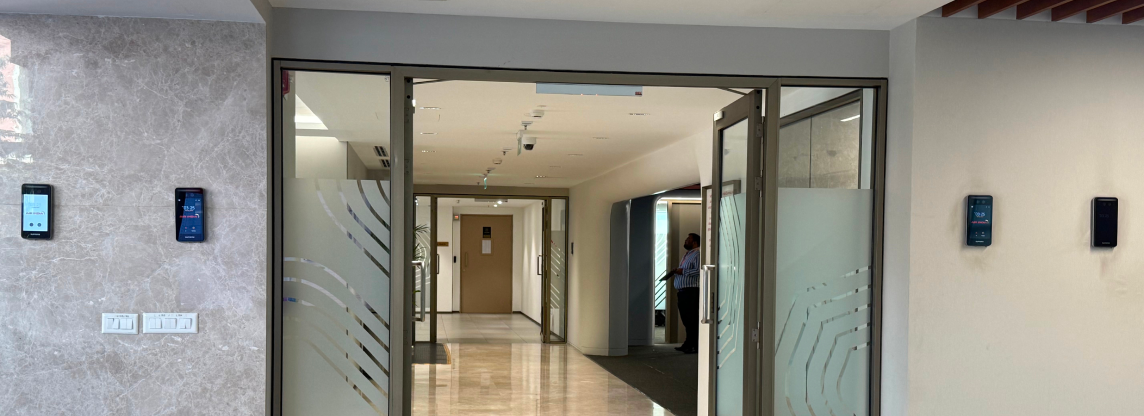
At headquarters, facial authentication has replaced legacy card-based access. Employees, consultants, and visitors use their faces as the key credential at main entrances, conference rooms, office doors, and other controlled areas.
Using BioStar 2's APIs, Magnum integrated access control with Microsoft Entra ID single sign-on, Veris visitor management, and the SAP HRMS system. These connections link physical access with identity administration, visitor management, time & attendance, payroll workflow, and wider security operations, streamlining day-to-day administration.
To accommodate different sites, Suprema and Magnum combined centralized and distributed access control architectures. Existing facilities could retain usable cabling and infrastructure, while newer locations could adopt readers with integrated controller functionality. This enabled modernization without unnecessary replacement work.
At the aviation training academy, Magnum addressed the enrollment bottleneck with QR-based self-enrollment using Suprema's integration capabilities. QR codes displayed on information screens and standees allow trainees to scan a code with their smartphone, enter an employee ID, complete one-time passcode verification, and capture a selfie for facial enrollment. Users can complete registration on arrival instead of relying entirely on advance email invitations, reducing friction at a high-volume site.
KEY BENEFITS➊ Card-free headquarters access
Facial authentication is the sole access method at Air India's headquarters, giving employees, consultants, and visitors a consistent, touchless experience across entrances, conference rooms, and offices while simplifying access operations.➋ Access control connected to business operations
BioStar 2 integrations connect physical access with identity, visitor, video security, and payroll-related workflows, supporting more effective attendance and roster management for employees, pilots, and cabin crew and improving operational oversight.➌ Practical enrollment for a mobile workforce
QR-based self-enrollment lets trainees complete verified facial enrollment when they arrive, reducing dependence on time-limited email invitations and accommodating irregular on-site schedules while keeping intake efficient.➍ Flexible modernization across facilities
Combining centralized and distributed architectures allows Air India to address different site requirements while making practical use of existing infrastructure and supporting a more efficient modernization program.➎ Multi-site implementation and continued expansion
What began at headquarters now spans 700+ doors across the headquarters, training center, and flying academy, serving 40,000+ users with approximately 530 active devices. Satisfied with the deployment's performance and Magnum's service support, Air India is extending the solution to MRO facilities in Bangalore and Delhi and BMTO in Bangalore, with approximately 1,000 doors targeted overall. -
FAST FACTS
-
LOCATION
Gurugram, India
-
YEAR OF COMPLETION
2022-2023
-
APPLICATION
Corporate office access control, aviation training facility access, employee and visitor access, and time and attendance managemen
-
TECHNOLOGY
AI-powered facial authentication, centralized and distributed access control, enterprise system integration, and QR-based self-enrollment
-
PROJECT SIZE
700+ secured doors, 40,000+ users, ~530 active devices
-
SUPREMA PARTNER
Magnum
-
SOLUTIONS
BioStar 2, BioStation 3, CoreStation 40, Door Module DM-20, Secure I/O 2
-
LOCATION